

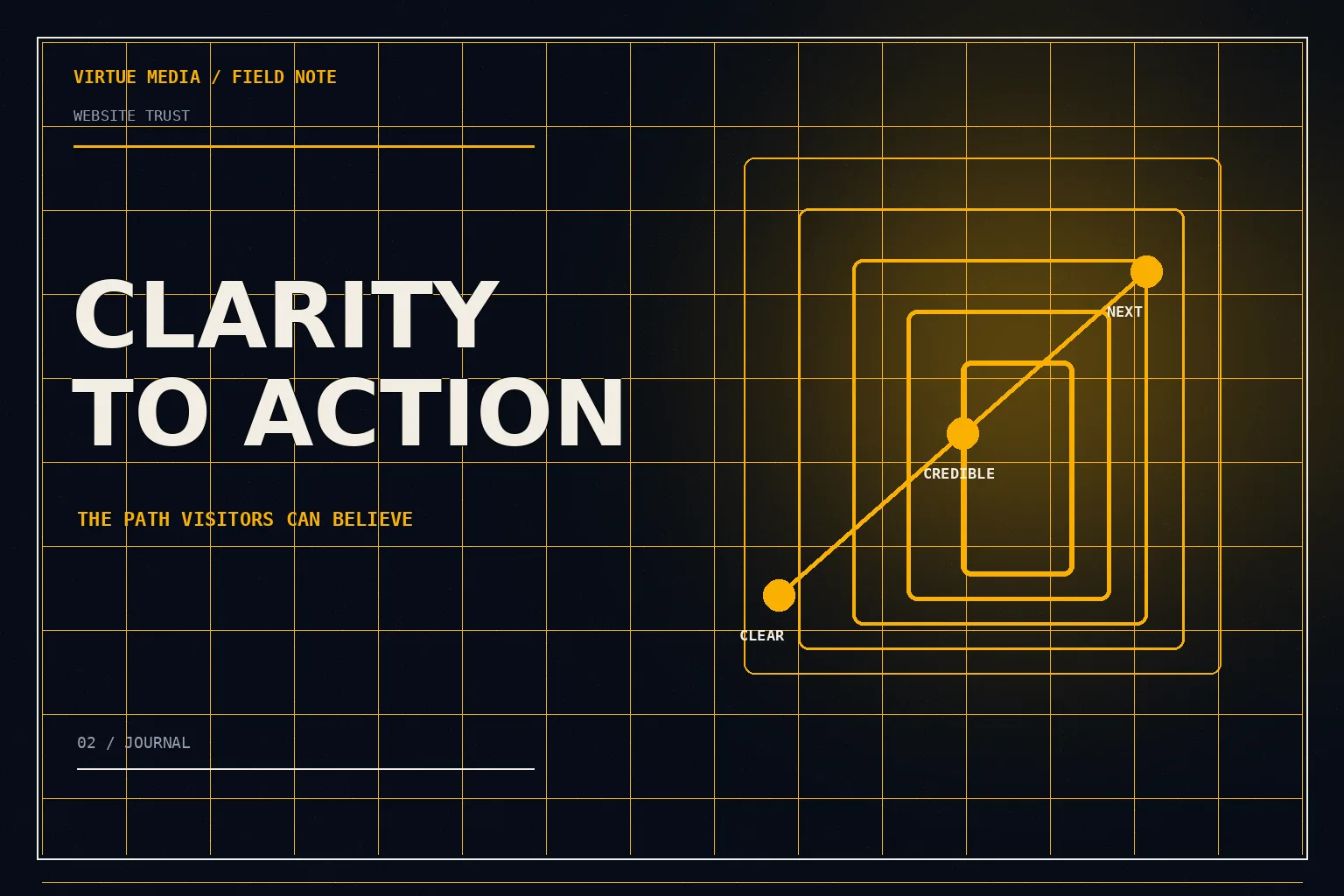
When a website underperforms, most teams assume they have a traffic problem.
Sometimes that is true. Often it is not.
Many small businesses and nonprofits are getting some attention already. People are hearing about them through referrals, social media, community reputation, events, or search. The real problem starts when those visitors arrive on the website and leave without gaining confidence. They do not understand what the organization does, who it helps, why it is credible, or what to do next.
That is not just a conversion problem. It is a trust problem.
Trust on a website is not built by saying "we care" or "we are passionate." It is built through clarity, relevance, and evidence. Visitors are asking a quiet set of questions the moment they land on your site:
- Am I in the right place?
- Do these people understand the kind of problem I have?
- Is this organization credible?
- Can I tell what happens next if I reach out?
If your website cannot answer those questions quickly, visitors hesitate. And when people hesitate online, they usually leave.
- The homepage leads with vague language
Many sites open with broad statements like "empowering excellence" or "solutions for a changing world." That language might sound polished internally, but it does not reduce uncertainty for a first-time visitor.
A stronger homepage explains three things fast:
- what you do
- who you help
- what outcome you help create
If a visitor has to scroll, interpret, or guess, your messaging is doing too much work in their head and not enough on the page.
- The site looks finished, but the thinking does not
Design matters, but polish is not the same as clarity. A site can have strong photography, modern layout, and smooth animations while still failing to answer basic business questions. Teams sometimes overinvest in presentation and underinvest in message structure, proof, and page hierarchy.
Visitors do not reward effort. They reward understanding.
- There is no visible evidence
Trust grows when visitors can verify what you claim. Depending on the organization, that evidence might include:
- client results or case studies
- testimonials with enough detail to feel real
- specific service explanations
- recognizable partnerships
- media mentions
- certifications, affiliations, or years of experience
Without supporting proof, even accurate claims feel thin.
- The path to action is unclear
A surprising number of websites do not tell users what to do next in practical terms. "Contact us" is not always enough. People want to know what happens after they click. Are they booking a consultation? Requesting a proposal? Starting a conversation? Downloading a resource?
Clarity lowers friction. Friction lowers action.
- The content does not match the audience's real concerns
If your audience is made up of business owners and nonprofit leaders, they are likely dealing with limited time, staff constraints, reputation pressure, and high expectations for results. Generic blog posts do not help much in that environment.
Useful content builds trust because it proves you understand the real operating context. It helps readers make better decisions before they ever speak with you.
That is one reason a blog-led website can outperform a brochure-style site. It gives you room to demonstrate judgment, not just announce services.
- The site feels abandoned
Trust drops when visitors see broken links, outdated copy, stale news, old copyright years, or obviously neglected pages. Even if your core service is excellent, a neglected website signals weak attention to detail.
For nonprofits, that can affect donor confidence. For businesses, it can affect sales confidence. In both cases, people start wondering what else is being overlooked.
What a stronger trust-building website does instead
A credible website does not need to be flashy. It needs to be disciplined.
In practice, that usually means:
- a homepage with a clear promise and audience fit
- focused navigation that reflects how people evaluate your offer
- service or program pages that explain outcomes and process
- visible proof that supports your claims
- articles that answer real questions your audience is already asking
- clear calls to action with low ambiguity
The goal is not to impress everyone. The goal is to make the right people feel confident enough to move forward.
A simple trust audit you can run this week
Open your homepage and ask five questions:
- Can a new visitor understand what we do in five seconds?
- Is it obvious who this site is for?
- Do we provide real proof, not just claims?
- Is the next step specific and easy to take?
- Does the site feel current and maintained?
If the answer to two or more is no, your website is probably losing trust before it has a chance to generate action.
The good news is that trust problems are fixable. They usually require sharper messaging, stronger structure, and better supporting content more than a complete reinvention.
That work is less glamorous than chasing trends, but it is far more useful.
If your website is attracting some attention but not producing enough confidence, that is the place to start.
0 Comments