

Field report by Sable Voss, Project Director. Second in a series on pushing a local, open-weights video model past what it is comfortable doing. Every number below came off our own render ledger.
MiniMax H3 is an open-weights video model that generates picture and synchronized stereo audio in a single pass, and it runs locally in ComfyUI. Our first field report asked whether it could produce something watchable on one consumer GPU. The answer was yes, at short length — a 94-second comedy, one character, six scenes.
The obvious next question is the one every studio actually cares about. Does it scale to long form? Not a clip. Not a promo. A scripted, character-driven episode with a cast, recurring locations, real dialogue and comic timing that has to land — the kind of thing a production company sells.
So we ran the experiment: six days, one RTX 3090 with 24 GB of VRAM, a full script, and MiniMax H3 doing every frame and every line of dialogue. Here is what came out, what it cost, and the single behavioural law that explains most of what went wrong.
Six days on one GPU
measured, not estimated
One 24 GB card, one operator, no cloud burst. Animation with performed dialogue, generated picture-and-sound in a single pass.
What long-form actually costs on MiniMax H3
Every benchmark you read quotes seconds per frame. That number is nearly useless for planning a production, because most of your GPU time goes into takes you throw away. The number that actually predicts a schedule is GPU hours per delivered minute — and it is governed almost entirely by how you cut the scene.
Takes per delivered shot, by how the scene is staged
from the render ledger · lower is cheaper
Same model, same recipe, same operator. The only variable is how many people are in frame and how the coverage is cut. A scene's cost is set by its staging, not its length.
Across the whole run that works out to roughly 3.5 GPU hours per finished minute, or about 60 hours for a 17-minute episode — two and a half days of continuous rendering on hardware that costs less than a used car. Only one shot in ten was usable on the first take. The median needed three.
The good news is that this number is not fixed. Our original plan priced the same work at 154 GPU hours; the locked recipe brought it to 22. Almost all of that came from two decisions — cutting the render resolution to 44% of the pixels, which costs drawing quality but measurably not lip-sync, and deleting the separate draft pass once quality at the lower resolution was good enough to ship.
One law explains most of the failures
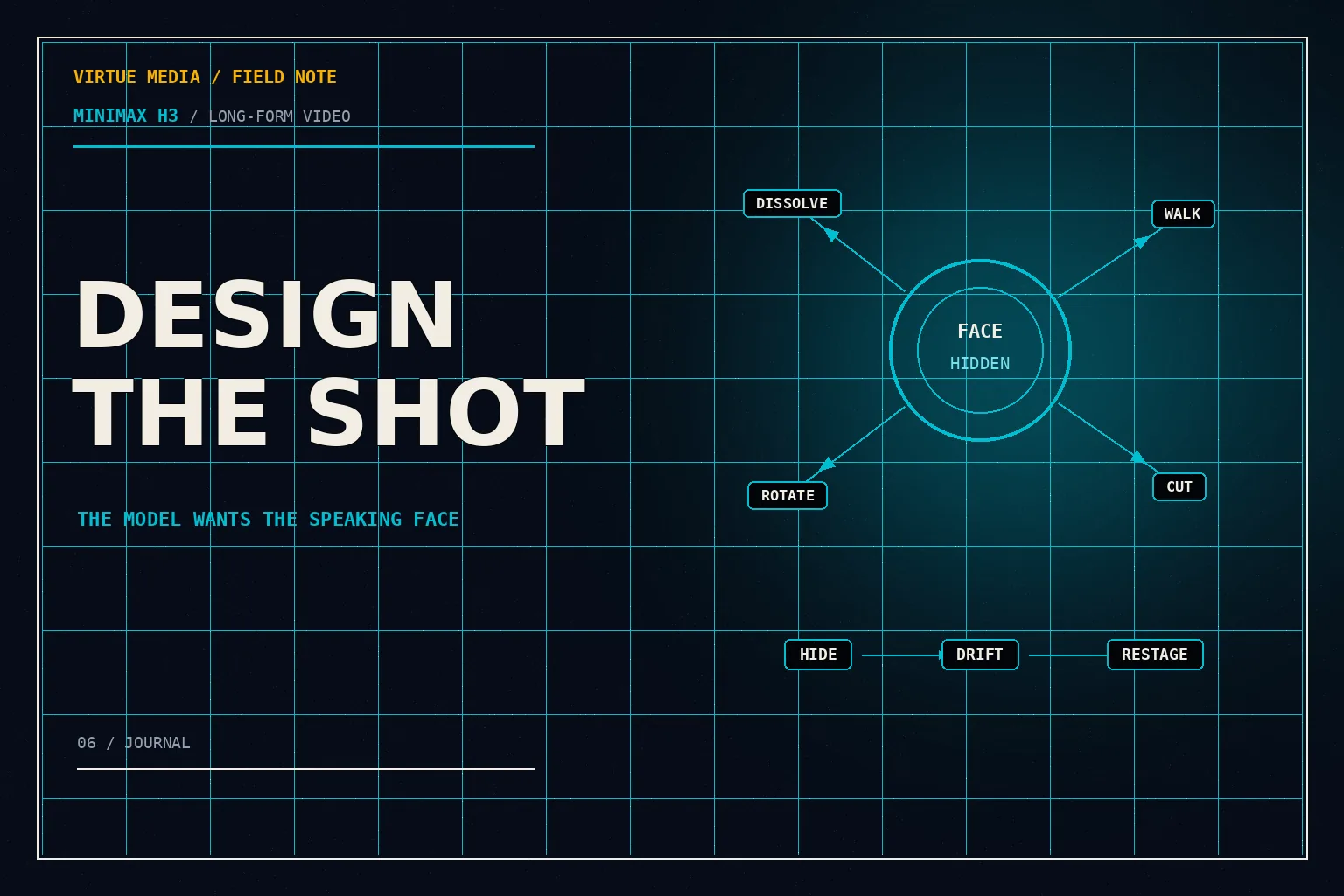
We spent days chasing four separate defects: shots that dissolved into a different room, cameras that drifted off their framing, actors who rotated to face the lens, and clips that inserted a cut nobody asked for. We treated them as four problems and wrote four fixes. Every one of those fixes measured null or made things worse.
They were one problem.
One pull, four escape routes
what happens when the speaker's face is hidden from camera
Block one route and it takes another. The fix is never a stronger sentence — it is giving the shot a design in which the speaker is already visible.
Once you see it as one pull, the remedy stops being a prompt problem and becomes a staging problem. Put the camera over the listener's shoulder and cut to the single when they speak — which happens to be how comedy has been shot for fifty years. The model is not being difficult. It is behaving like an editor who has been told to hide the most interesting thing in the frame.
Five things we learned about telling it what to do
Each of these came out of a paired test — same random seed, one variable changed — because on a stochastic model an opinion is worth nothing and a controlled pair is cheap.
1. A prohibition cannot beat a noun
An object kept appearing in a character's hands. We forbade it, in progressively firmer language, eight takes running. Then we looked properly at our own prompt and found the object named four times elsewhere in the same text, as part of the scene description. Deleting those mentions solved it on the next take.
Two ways to remove a thing from a shot
same shot · same seed · same model
Timing gave the mechanism away: hands empty at 3.5 s, object present by 5.5 s. The model was responding to the noun, not ignoring the ban — a clause it ignored would have been ignored from the first frame.
Before you write "no X" into a prompt, search your own prompt for X. You are usually arguing with yourself.
2. Never describe the end of the clip
Naming a composition at a moment in time — "in the final beat, he is still turned away" — gives the model two frames to interpolate between, so it animates the camera to get there. It fixed the ending and broke the opening, three times out of three. A continuous state — "his gaze stays on her for the entire clip" — costs nothing and holds. The hazard is naming an endpoint at all, not describing the same thing twice.
3. Verbs keep props; possessives lose them
A named character performing an action on an object holds onto it. A static phrase — "the object held out of reach" — hands the object to whichever character is nearest in the sentence. One shot passed on its first take with verbs where another burned three takes on a possessive.
4. Direction between lines becomes literal silence
We added acting direction to lift the performances, and it worked — measurably, on pitch contour and dynamic range. It also quietly wrecked the comic timing, because a sentence about what a character does after the other stops talking renders as elapsed time. Half a second of dead air where the joke needed a tenth. Reaction has to be described as happening during the other actor's line.
5. The picture outranks the sentence
Reference images do more than you think. We passed empty-room plates to keep locations consistent, and they worked — but a plate does not only supply a background. It supplies a composition. Hand the model a wide room plate for a shot you intended as a close single and it opens on the plate's framing, then walks to yours. We rewrote the text three ways to fix that. Nothing moved. Cropping the reference image to the shot's framing moved it 16 times as much as the best wording change.
The defect your tools cannot see
We built a stack of automated gates: framing checks, transcript comparison against the script, audio integrity, flicker and artifact detection. They caught a great deal. They share one blind spot, and it is structural rather than a bug.
Every metric checks a property of something that is present. A character who simply is not in the shot has no properties to measure. An empty chair, a missing actor, a duplicated body, a line the model invented rather than misheard — all of them score clean.
Two defects entering the same QC stack
one is stopped · one arrives at the edit
Absence passes silently. Three of these reached delivered footage and every one was caught by a person scanning a contact sheet — which is why a human review pass is not a formality you can automate away.
A related caution: verify what your instruments actually measure. Our audio checker reported clipping on a third of clips and had us attenuating clean takes for days. It was summing centre-panned stereo to mono, which inflates a peak by exactly 3.01 dB. Nothing in the production had ever clipped.
How to be wrong less often
The methodology lessons cost us more takes than the craft ones.
- Derive from one, believe after four. Three rules we built on a single observation each all failed against the wider class. Test a candidate rule against every case you can cheaply reach before rolling it out.
- If it reproduces at a second seed, the prompt is causing it. The highest-yield diagnostic we have, and it costs nothing: reproducible across seeds means stop re-rolling and read your spec; unique to one seed means take a fresh seed and move on. Getting that backwards burns hours.
- Re-author, don't re-roll. Nineteen takes of one over-long shot produced nothing usable. Six takes after splitting it in two produced two finished shots.
- Validate on the case most likely to break. The test that credited our acting direction ran on a slow, quiet beat — so it structurally could not detect that the change was adding dead air to fast exchanges.
What this model tells without a fight
All of the above is really an answer to one question: given how the thing actually behaves, what form should you point it at? Ranked by measured production friction, easiest first.
Story formats by production friction
bar length = relative cost per finished minute
The expensive end is not exotic. It is the most normal thing on television — a long scene between people, cut in over-the-shoulder coverage.
Four constraints shape any choice you make here:
- There is no voice cloning. Casting is re-rolled on every take. A character's voice has to be re-won shot by shot, judged against the last take you accepted. In anything dialogue-heavy this is the dominant cost, and it is the reason format choice matters as much as it does.
- Clips run five to fifteen seconds. Structure in beats, not scenes. Word count drives clip length, so a dense speech is not one shot — it is four, and they have to cut together.
- Off-screen voices are fragile. Keep to three turns per clip with at least one on-screen answer, or the visible actor starts mouthing the other character's lines. Past that, split it: record the off-screen voice as its own take, shoot the picture silent, cut to the audio. No lip-sync risk by construction — and because the model renders no room tone, the joins are silent.
- The camera will not hold a move. Author locked-off. Every attempt we made to direct a camera move either drifted or was replaced by a slow push-in the model invented on its own.
If you want the cheap path to a series
Make it a mockumentary.
The confessional format is, shot for shot, the cheapest thing this model produces, and it converts all three of its biggest weaknesses into non-issues. Voice re-casting stops mattering when each character speaks alone to camera. Off-screen dialogue stops mattering when the interviewer is never heard. Coverage stops mattering when the grammar is one locked-off single.
It is not a compromise, either. That format is the native language of modern comedy, and the to-camera material in our own run has the tightest timing of anything we produced. The scenes played straight then become the expensive spice you spend takes on deliberately, rather than the default you pay for on every page of the script.
Virtue Media builds and tests these pipelines in-house before we put them anywhere near client work. If you are weighing where generative video actually fits in your communications — and where it does not — see how we approach AI automation, or bring us the problem.
0 Comments